
The customers you already have
Millions of individuals in Asia Pacific run micro, small and medium-sized enterprises (MSMEs) without ever calling themselves business owners. They sell at weekend markets, bake or cater from home, tutor students, or run micro-retail operations from their social media apps. Many already hold personal debit cards and use banking apps in their daily lives.
For issuers, that creates a strategic tension: the customer relationship may already exist, but the merchant relationship may not. These sellers may be visible as consumers, while their business payment activity remains invisible or under-monetized.
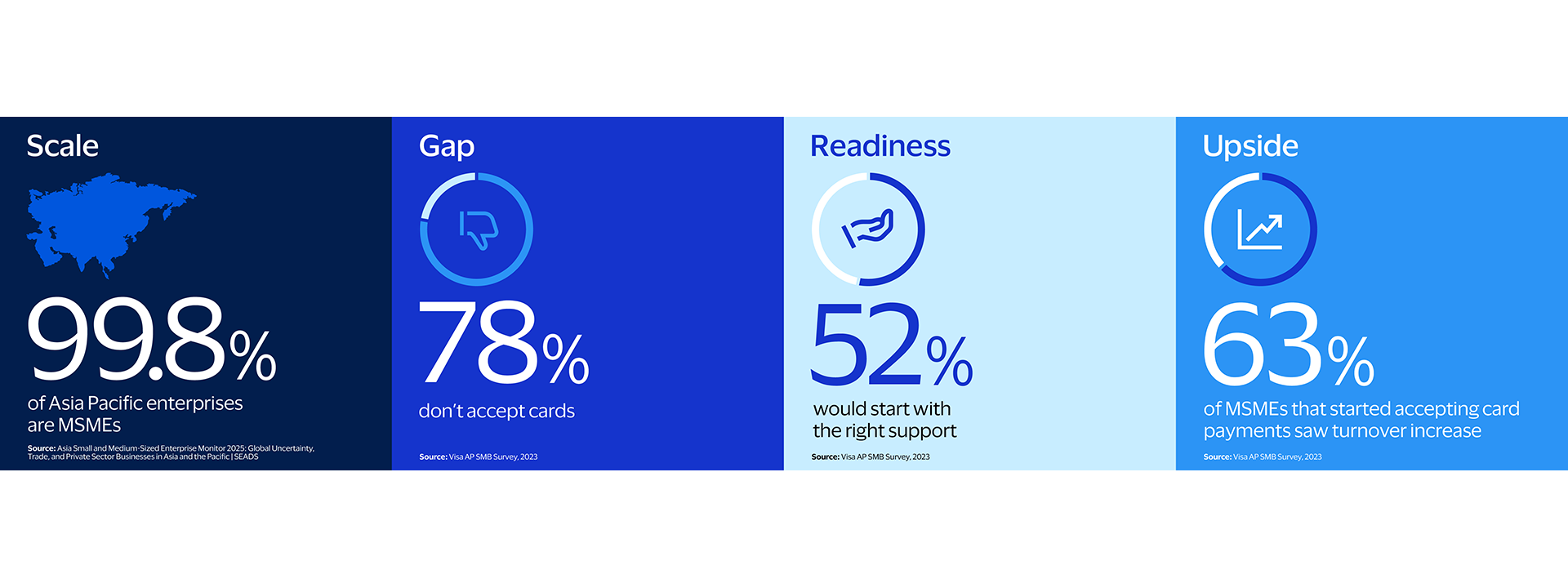
About 99.8% of all firms in Asia Pacific are MSMEs,¹ highlighting the sheer scale of entrepreneurship in the region. But many remain underserved by the financial sector as they operate informally, and lack the scale and credit history required by conventional banks. For issuers, the significance is that this is not only an external merchant market. Rather, part of it may already exist within their own customer base.
Visa’s research shows that 78%² of MSMEs in Asia Pacific rely on cash, bank transfers, QR code payments or digital wallets, but do not accept cards. That means a sizable share of seller activity may be taking place without card acceptance, even when the seller is already known to the issuer. Cards can be valuable in complementing these existing methods of payment.
This is missed revenue hiding in plain sight. When business payments do not involve cards, issuers lose transaction volume, seller engagement, visibility into seller behavior and an early path to the future small and medium-sized business (SMB) relationship.
“In all the markets we researched, there’s a vicious cycle,” says Maria Peralta Giraldo, Director, Growth Products, at Visa Accept. “As small merchants don’t normally accept cards, buyers don’t know they can pay with a card, and then sellers think that nobody wants to pay with a card. But we believe there’s money left on the table for sellers, and buyers are not necessarily paying with their preferred payment method.”
Filling that payment gap rapidly is essential. Seller habits tend to form quickly and the payments landscape is evolving fast. The use of wallets, QR ecosystems, payment service providers (PSPs) and fintech platforms has expanded rapidly, with micro-sellers finding them effective in getting paid easily and reliably. If sellers add cards to their toolkit, they will open up a complementary payment option that can help bolster their business. As each payment option plays a distinct role in supporting sellers, together they can strengthen the overall payments ecosystem by offering flexibility and broader opportunities for business growth.
Issuers have a timely advantage: many of these sellers may already be in their own debit portfolios, and can be activated as card acceptors quickly through Visa Accept.
The growing tendency to use multiple digital payment tools aligns with broader digital-economy priorities in Asia, particularly around micro and small business inclusion.
Eranga Weeraratne, Deputy Minister of Digital Economy, Government of Sri Lanka, says: “Sri Lanka’s digital economy is entering a transformative era — one defined by inclusion, innovation, and empowerment. The launch of Visa Accept is a timely and strategic innovation that directly supports our national mission to accelerate the adoption of digital payments, particularly among micro and small businesses, as we advance toward building a cashless society.”
A way forward with cards
Visa Accept gives issuers a practical way to act on this portfolio opportunity. A micro-seller with a personal Visa debit card can apply for Visa Accept through their personal banking app. Once onboarded and approved, they can start accepting card payments on their mobile phone, creating a simple and affordable point-of-sale option without needing additional hardware.
For issuers, this can turn an existing debit relationship into an active card acceptance relationship, helping bring business payment flows back into the card ecosystem.
Card acceptance can help MSMEs reach customers they may currently miss, including tourists, younger shoppers and professionals who prefer paying by card. Across markets, sellers see cards as a way to professionalize their image, serve card-first customers and support higher-value transactions. Visa Accept appeals as it removes infrastructure and cost barriers to card acceptance.
The demand is already visible across the region. In Sri Lanka, sellers report interest from educated customers and those making bulk or big-ticket purchases. In the Philippines, card payments are seen as a way to professionalize and advance a seller's image. In Malaysia, one of the most card-mature markets in Southeast Asia, Visa Accept appeals strongly as it removes the infrastructure and cost barrier to card acceptance, while helping sellers nudge customers towards higher-value transactions.
Perhaps most importantly, sellers receive funds almost immediately in their bank accounts, adding a level of convenience and transparency that is critical for daily cash flow. Visa research shows that 63% of MSMEs³ that started accepting card payments saw their turnover increase.
For issuers, these seller benefits matter because they can translate into greater card transaction volume, more frequent engagement and richer signals of business activity.
The hidden advantage
This is where card issuers have a unique advantage. They already have relationships with individual cardholders, trusted digital channels and a role in customers’ daily financial lives. Visa Accept helps issuers identify potential sellers within that base and give them a way to start accepting card payments.
The first acceptance relationship is critical because payment habits form early. When an issuer supports that first card transaction, it can begin building a more durable seller relationship, grounded in transaction insight, regular engagement and the ability to support broader financial needs over time.
It also protects the future SMB opportunity. As micro-sellers grow, the issuer that supported acceptance early is better positioned to remain part of the relationship when the seller needs more formal business banking products.
The card acceptance gap is more than an underpenetrated market. It is a decision point for issuers: those that move early can convert existing debit relationships into active acceptance relationships, support sellers as they grow and build a more defensible path into SMB banking.
Sources